

Book Review: DADDY!
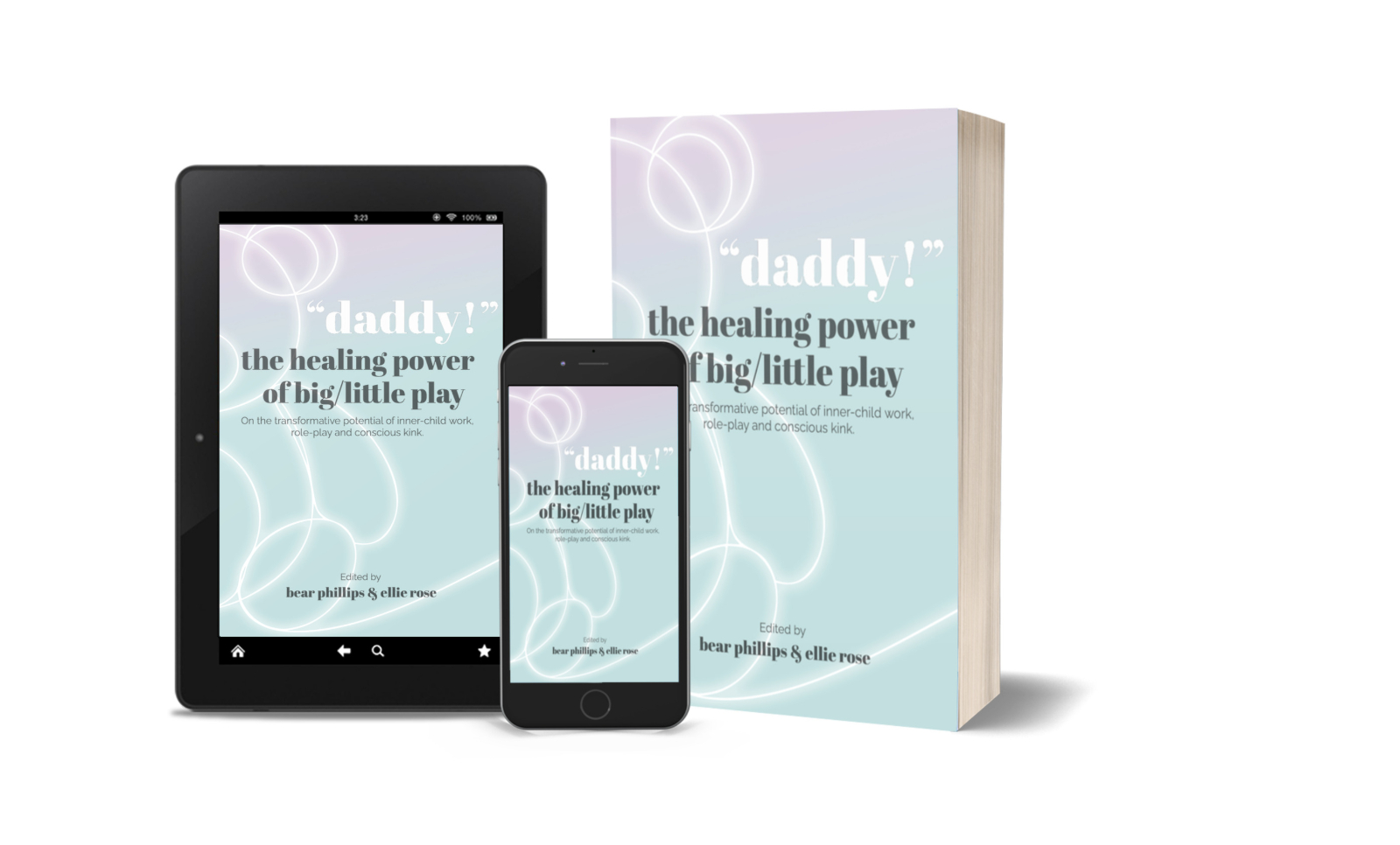
Book Review: “Daddy! The Healing Power of Big/little Play” by Bear Phillips & Ellie Rose
Sometimes I feel exhausted by the world. And I find it hard to let that show. We live in a society where vulnerability and softness are given very limited space. More often than not, they are read as weakness. Against this backdrop, it feels significant when spaces open up that allow these qualities to be explored again, outside of ideas of performance or strength.
Spaces for vulnerability
“DADDY! The Healing Power of Big/little Play”, edited by Bear Phillips and Ellie Rose, is such a space. The book brings together 17 contributions by 14 authors (therapists, academics, kinksters, creatives) and offers very different ways of thinking about care, intimacy, power, and vulnerability in lived relational contexts.
The anthology brings together many different voices between theory, personal reflection, poetry, erotic fantasy and lived experience. They made me think, smile and some pieces were simply deeply moving. Together they create a very real sense of how diverse and emotionally complex Big/little dynamics can be and how much fun, desire, playfulness and lightness they can hold.
I am also proudly part of this anthology, with my chapter “Claiming the Right to Care: Feminism, Ethics & the Politics of Permission”. In it, I look at care as something deeply human that is often unevenly distributed, especially when it comes to who is allowed to give care and under what conditions.
Inner worlds and what we mean by “needs”
Across many of the contributions, there is a strong focus on inner experience and vulnerability. A lot of the writing returns to a simple but important question: how do we recognise and relate to our needs in the first place?
“I needs pancakes.”
“Needs or wants?”— from Just Us by AJ
Throughout the book, it becomes clear that needs do not always belong in one single relationship, simply because they cannot always be met there. Part of the work in these texts is to take this seriously without turning it into failure or lack.
This shifts the focus away from ideas of perfect mutual fulfilment and towards something more grounded: clearer language around boundaries and what is actually possible between people.
Vulnerability doesn’t have to be “solved”. We are allowed to be.
Care and Safety
Closely connected to this is how care and responsibility are described throughout the book. Care is rarely framed as one-directional. It moves between people.
I cared for others with tenderness and thoughtfulness, not able to ask for my own needs to be met, and not equipped in kindness for myself.
— from Daddy! Am I pretty? (Loved? Wanted? Worthy?) by Sian Johnson
In this sense, care is an ongoing negotiation: between self-responsibility and an honest sense of what is actually possible.
The book also returns again and again to the question of safety. Safety is something we practise. It shifts with experience and with communication. It is closely tied to uncertainty. Instead of existing in opposition to risk, safety here seems to depend on how risk is shared and held together. This, to me, is what responsible conscious kink looks like, and it is something that is reflected throughout the book.
Fluid roles, shifting meanings
Another thread through the anthology is the way fixed relational roles are questioned.
We identify as trans* and non-binary, although we have the body parts of a hetero couple. Neither of us fits with common binary titles. I have called you both mommy and daddy in the past, but neither feels quite right, albeit fun in some circumstances. You must have been the first one to call me Mapa, a portmanteau of mommy and papa.
— from mapa: trans* queer switches play around . . . by Kale Tadpole & Nino Angel
Terms like “Daddy”, “Mommy”, or “Little” appear as fluid relational positions that change depending on the dynamic and the people involved. In this space, familiar ideas about gender and desire are gently loosened. Queerness here feels like a way of staying open to ambiguity and change.
Things get difficult
One of the strengths of the book is that it does not avoid the more uncomfortable parts of these dynamics. The chapters engaging with age play and CNC (consensual non-consent), for example, show how strongly these practices are shaped by misunderstanding and social discomfort.
Rather than smoothing this over, the authors stay with the tension. Friction is treated as something to think with, especially when talking about intimacy and power. That’s something I was totally amazed by while reading. The result is sharper and more careful questions.
Big/little play is not about unresolved daddy or Mommy issues. That’s what therapy is for! As such, it is typically disconnected from experiences of our actual parents or caregivers and reflects more our archetypal understanding of these roles.
— from myths & misunderstandings by Bear Phillips
Alongside the ideas and themes, there is also a strong emotional layer to many of the texts. Some contributions leave an after-effect. The piece by Anon & Nona, in particular, stayed with me in a very direct way. I cried more than once. There are moments in this book that are deeply felt.
It can be more difficult with selves like Lyssa, to even realise they are child selves – or that they carry early trauma – because they can seem so adult at times. That often seems to be the case for critic selves. It’s hard to recognise them as just as vulnerable as more obviously sensitive littles like Benji.
— from an age play about age-play by Anon & Nona
“Daddy! The Healing Power of Big/little Play” keeps a process open. Again and again, it returns to learning and unlearning. It keeps questions alive. And at the same time, it is playful, lustful and incredibly entertaining.
I am grateful, proud, and very happy to be part of this beautiful work. Get your copy here: “Daddy! The Healing Power of Big/little Play”
Empathy
Empathy is my compass. Join me in a space where empathy guides us to connect on a profound, soulful level.
Integrity
At the heart of the journey lies a commitment to integrity. Honesty, transparency, and ethical conduct. In this space, you’ll find a sanctuary built on trust.
Inclusivity
Diversity is strength, and inclusivity is a necessity. A safer space that welcomes all colors, shapes, and stories. It’s not just about fitting in; it’s about celebrating the beauty of standing out together.